Monday, April 24, 2017


Assessment of Young Learners Instructions


Hello everybody, I am back to share all about two articles that I read explaining different ways teachers have to evaluate the learning of young child. In both articles I found the development of Early Literacy skills, Instructional Activities to Promote Early Literacy Skills, and one of the many important ways that I could use to evaluate the child.


Theme: Development and Significance of Early Literacy Skills
Evidences
Article #1 ASSESSMENT OF PRESCHOOL EARLY LITERACY SKILLS: LINKING CHILDREN’S EDUCATIONAL NEEDS WITH EMPIRICALLY SUPPORTED INSTRUCTIONAL ACTIVITIES
According to Assessment of Preschool Early Literacy Skills: Linking Children’s Educational Needs with Emprically Supported Instrutional Activities Children who are poor readers tend to continue to struggle with reading and writing, and read less than their peers who are more skilled in reading. As a consequence, children who are poor readers tend to receive less practice in reading and less exposure to content knowledge, vocabulary, and other language skills than do children who learn to read early and well (Cunningham & Stanovich, 1998; Echols, West, Stanovich, & Zehr, 1996; Morrison, Smith, & Dow-Ehrensberger, 1995). Knowledge about the causes, correlates, and predictors of children’s reading success and reading failure in the early elementary grades has expanded greatly in the past several decades (e.g., National Reading Panel, 2000; Snow, Burns, & Griffin, 1998). This knowledge has been incorporated into methods of identifying, monitoring, and helping struggling readers in the elementary school grades. More recently, research has highlighted the significance of the preschool period for the development of skills that contribute to children’s acquisition of reading skills (Whitehurst & Lonigan, 1998).”

References

Christopher J. Lonigan , Nicholas P. allan, and Matthew D. Lerner. (2011). Assessment of Preschool Early Literary Skills: Linking Children's Educational needs with Empirically Supported Instructional Activities. psichology in the Schools , 15.


Article #2 CLOSING THE GAP EARLY: IMPLEMENTING A LITERACY INTERVENTION FOR AT-RISK KINDERGARTNERS IN URBAN SCHOOLS.
 According to Closing the Gap Early: Implementing a Literacy Intervention for At-Risk Kindergartners in Urban Schools “It is well known that a performance gap in literacy achievement exists for students in urban schools from socioeconomically disadvantaged backgrounds and that these high-needs communities typically have a greater proportion of at-risk students (Flood & Anders, 2005). In the development of reading and writing skills, the academic performance gap is evidenced early on as a deficit or lag in oral language and emergent literacy (i.e., phonological awareness and letter-sound knowledge) skills (Adams, 1990; Bradley & Bryant, 1983). Unfortunately, students who have early difficulties in oral language are at risk for later reading problems (e.g., Menyuk & Chesnick, 1997). To address this challenge in literacy education, researchers are documenting literacy initiatives or programs that have been particularly successful in improving literacy achievement for students in urban school districts (e.g., Teale & Gambrell, 2007). Christopher J. Lonigan, Nicholas P. allan, and Matthew D. Lerner. (2011).

References

Christopher J. Lonigan , Nicholas P. allan, and Matthew D. Lerner. (2011). Assessment of Preschool Early Literary Skills: Linking Children's Educational needs with Empirically Supported Instructional Activities. psichology in the Schools , 15.


Theme: Instructional Activities to Promote Early Literacy Skills


Evidences
Article #1 ASSESSMENT OF PRESCHOOL EARLY LITERACY SKILLS: LINKING CHILDREN’S EDUCATIONAL NEEDS WITH EMPIRICALLY SUPPORTED INSTRUCTIONAL ACTIVITIES
 Christopher J. Lonigan, Nicholas P. allan, and Matthew D. Lerner. (2011). found "Although not as well researched as interventions for older children, there is a growing body of research supporting the use of instructional practices and activities to promote preschool children’s early literacy skills (see Lonigan, Shanahan, & Cunningham, 2008; Lonigan, Schatschneider, & Westberg, 2008b; see also the What Works Clearinghouse [WWC] website at www.whatworks.ed.gov). These research reviews identify instructional practices that are supported by causally interpretable evidence (i.e., research studies that rule out alternative explanations for observed gains in children’s skills). The types of instructional practices related to reading outcomes that are supported by research can be grouped into two categories: those that promote the skills primarily associated with decoding print (i.e., code-related skills) and those that promote the skills primarily associated with comprehending what is read (i.e., meaning-related skills).”


References

Christopher J. Lonigan , Nicholas P. allan, and Matthew D. Lerner. (2011). Assessment of Preschool Early Literary Skills: Linking Children's Educational needs with Empirically Supported Instructional Activities. psychology in the Schools , 15.


Article #2 CLOSING THE GAP EARLY: IMPLEMENTING A LITERACY INTERVENTION FOR AT-RISK KINDERGARTNERS IN URBAN SCHOOLS
 Christopher J. Lonigan , Nicholas P. allan, and Matthew D. Lerner. (2011).Study found the following: Our KELT program is unique in that the K tutors were provided with a specific    curriculum based on the Ontario Ministry of Education (2006) kindergarten program and oral-language developmental continuums (Brailsford & Stead, 2006). An intervention program must be specific and focused, not just more of the same thing over a longer period of time. Specific expectations from the areas of oral language and reading were selected by the education and ESL (English as a second language) consultants and the speech-language pathologist to address oral- language and emergent-literacy skills (see Table 1). The expectations directly link to the assessment tools that are administered.

References

Christopher J. Lonigan , Nicholas P. allan, and Matthew D. Lerner. (2011). Assessment of Preschool Early Literary Skills: Linking Children's Educational needs with Empirically Supported Instructional Activities. psichology in the Schools , 15.


 Theme: Standardized Assessment

Evidences
Article #1 ASSESSMENT OF PRESCHOOL EARLY LITERACY SKILLS: LINKING CHILDREN’S EDUCATIONAL NEEDS WITH EMPIRICALLY SUPPORTED INSTRUCTIONAL ACTIVITIES
Christopher J. Lonigan , Nicholas P. allan, and Matthew D. Lerner. (2011).Study found the following: A   standardized measure is one in which a common set of stimulus materials and questions, a consistent set of administration procedures, and conventional scoring procedures are used, and the scores are often based on a norming sample. Standardized measures allow meaningful comparisons among children (or between assessments of a single child over time) because they (a) have clear and consistent administration and scoring criteria (i.e., the measure is always given and scored in the same manner), (b) demonstrate generally good reliability and validity, and (c) raw scores are converted into scores that reflect a child’s performance relative to the performance of a normative group. Because the assessment is the same for each child administered the measure, resultant scores have consistent meaning across children, examiners, and assessment sites. Standardized measures are usually normed within large and representative samples. Two types of standardized measures have potential utility for identifying children who need additional instructional support for early literacy skill development: screening/progress monitoring assessment and diagnostic assessment.

References

Christopher J. Lonigan , Nicholas P. allan, and Matthew D. Lerner. (2011). Assessment of Preschool Early Literary Skills: Linking Children's Educational needs with Empirically Supported Instructional Activities. psichology in the Schools , 15.


Article #2 CLOSING THE GAP EARLY: IMPLEMENTING A LITERACY INTERVENTION FOR AT-RISK KINDERGARTNERS IN URBAN SCHOOLS

According to Closing the Gap Early: Implementing a Literacy Intervention for At-Risk Kindergartners in Urban Schools “the evaluation of the KELT program involved a quasi-experimental design in which students in the program (KELT group) and those not in the program (comparison group) were longitudinally tracked on measures of oral-language and emergent-literacy skills over the kindergarten school year. To assess the effectiveness of the program for enhancing students’ oral-language and emergent-literacy skills, we carried out a repeated-measures multivariate analysis of variance (MANOVA). We had one within-subjects factor (time: pretest vs. posttest) and one between-subjects factor (program group: KELT group vs. comparison group) on six dependent variables (six assessments in the battery). This analysis found significant program group by time interactions for four of the six assessments: concepts of print (F[1, 74] = 19.52, p < .01), phonemic awareness (F[1, 74] = 4.43, p < .05), letter-sound knowledge (F[1, 74] = 6.83, p < .01), and word knowledge (F[1, 74] = 19.30, p < .01). As shown in Figures 2 and 3, across four of the six assessments, the KELT group’s average rate of growth was faster than the comparison group’s. Note that these results included phonemic awareness and letter-sound knowledge, two critical skills shown to support the development of English reading (Adams, 1990; Bradley & Bryant, 1983), achieved as a result of instruction in the con- text of meaningful learning experiences.”


References

Christopher J. Lonigan , Nicholas P. allan, and Matthew D. Lerner. (2011). Assessment of Preschool Early Literary Skills: Linking Children's Educational needs with Empirically Supported Instructional Activities. psichology in the Schools , 15. 


Friday, February 24, 2017


Orlando's Case Study


    Orlando is a seven-year-old boy in the first grade who struggles with comprehension skills when reading independently. Due to his lack of progress, his teacher has set goals for him to achieve by the end of the school year.
   The school's reading specialist has suggested to implements specific reading strategies, repeated readings, and graphic organizers.

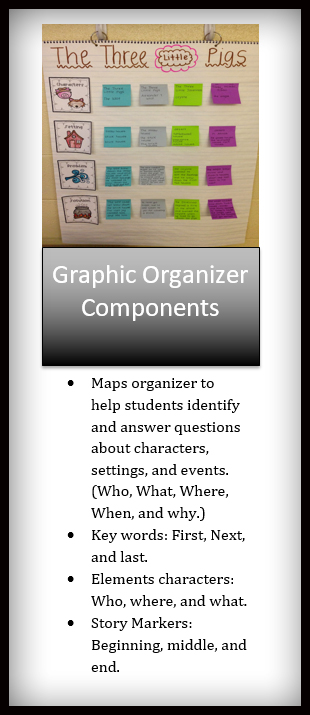
Graphic Organizer

     In my opinion the three strategies are very useful in Orlando case. But the first one, graphic organizer is the most important, because combines visualization with the learned vocabulary to help understand Orlando easier what happened in the story further encourage him to think critically. The graphic organizers can be used to compare and contrast, analyze relationships, brainstorm, explore concepts or just take notes, help students see their reading and writing instruction in a new way. The graphic organizer is a simple diagrams used to assist students, at any grade level.       
    As early as kindergarten, students can use simple maps to identify who, what, where, when and why of a story or sequence the events of a story.
   The graphic organizer has many tips for implementation, and serves to help students to identify and respond questions about characters, settings, and events.

      There are many examples of a tips implementation that we know, some of them are·         Retell the story by using key words: first, next, and last. With this words the students learn the sequence of the story. The students learn to understand what happens first in the story and what comes after.
·            Retell the story by using story elements characters (who), setting (where), and plot (what). When the students use elements characters helps them to associate names with the story and it is much easier for them to become familiar with the new vocabulary from the story.
·         Retell the story by using story markers: beginning, middle, and end. This tips is very important because in this way the students learn about sequence and learn also in which order happened the events.
·         Use imagery to create a mental picture of the story.  Do everything you can to show in addition to (Fountas & Pinell Literacy, 2009).
      Recent research shown us: Students at-risk for reading difficulties require systematic, explicit instruction and more repetition to develop important reading skills (Babyak, Koorland, & Mathes, 2000; Foorman & Torgesen, 2001)
·         The purpose of teaching students to use graphic organizer is to provide students with meta-cognitive tools that they can (eventually) use on their own (Swanson & De la Paz, 1998).
·             The visual framework of a graphic organizer provides an organizational format for reading text that has been shown to help children with learning disabilities increase reading comprehension skills (Babyak, Koorland, & Mathes, 2000; idol, 1987).


Repeated Reading
    When we start to think how the repeated reading helped Orlando we arrived at the conclusion that with this strategy Orlando acquires more fluency in reading and creates a connection through repetition gaining in automatically word recognition skills.
      Repeated reading of a book leads to an increase in vocabulary when compared to reading a book just once and moving on to the next one. This has been proved by numerous studies. During the first reading of a book, the reader is introduced to the story. In subsequent readings, the child is able to look beyond the ‘newness’ of the story, the characters and events, to comprehend how things fit together and work. As words are repeatedly revisited, children have the opportunity to hear and practice decoding words. When words are frequently decoded, learning is consolidated.
Repeated Reading Facilitates Predictability. Being able to predict what will happen next enables children with a sense of mastery. They can recall what has happened, make sense of the events and place them in order. All of these things are necessary life skills, which children will use over and over again through the years to follow. Re-reading enables children to foster cognitive skills needed to predict what will happen next.

Comprehension Strategies

          The comprehension strategies help to him to understanding of what has been read moreover Orlando acquire a systematic approach to introducing vocabulary and background information. The young children learning the structure of different kinds of texts through comprehension strategies. When we mention meta-cognition can be defined as "thinking about thinking." Good readers use meta-cognitive strategies to think about and have control over their reading. Before reading, they might clarify their purpose for reading and preview the text. During reading, they might monitor their understanding, adjusting their reading speed to fit the difficulty of the text and "fixing" any comprehension problems they have. After reading, they check their understanding of what they read. With the children happens exactly the same, first the teacher before reading history provides information to create a base on which the student can connect the story they read with the knowledge they already have.

          The Question-Answer Relationship strategy (QAR) encourages students to learn how to answer questions better. Students are asked to indicate whether the information they used to answer questions about the text was textually explicit information (information that was directly stated in the text), textually implicit information (information that was implied in the text), or information entirely from the student's own background knowledge.

      Usually, I use this Story Map to combine technology with literacy. I also create activities where the children can fill the map with the different pictures of the story. It is very fun for them and this way they always remember the story with each details.


References:


  • Pinnell, G. S., &amp; Fountas, I. C. (2011). Literacy beginnings: a prekindergarten handbook. Portsmouth, NH: Heinemann.
  • Http://iris.peabody.vanderbilt.edu/Early reading Level A. Case 4 Seven strategies to teach students text comprehension. (2009, August 5).
  • Retrieved February 24, 2017, from http://www.readingrockets.org/article/seven-strategies-teach- students-text- comprehension.
  • ReadAloud-https://www.teachingchannel.org/videos/pre-k-reading-comprehension.